get in touch
What Is AI Visibility, and Why Should SMEs Care?


AI visibility is one of those phrases doing the rounds at the moment. It sounds like jargon, and a lot of what gets written about it is jargon, but the idea underneath is straightforward.
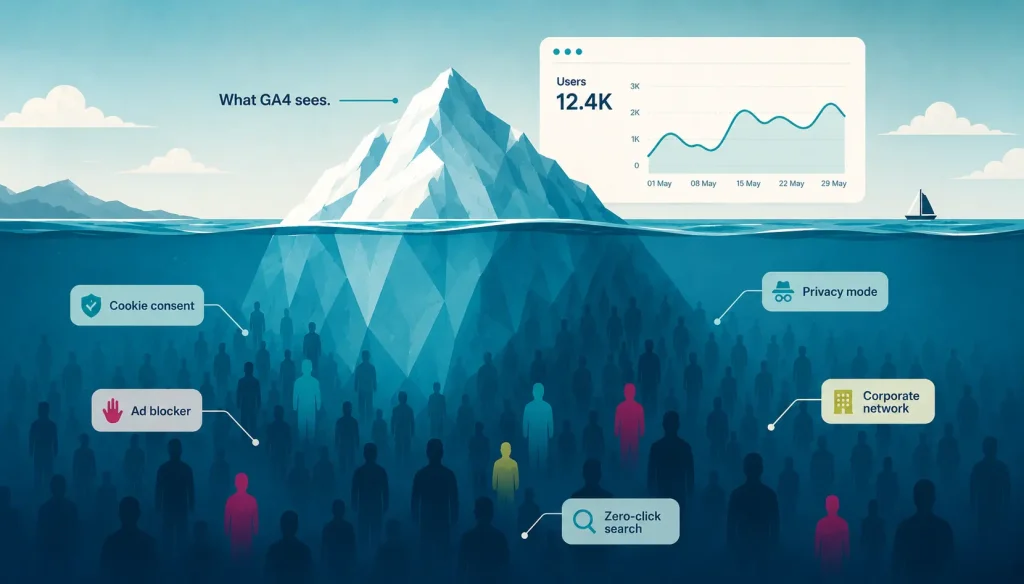
People are starting to use AI tools to find things, compare options and decide who to buy from. Google is increasingly adding AI-generated answers into its search results. ChatGPT, Gemini and Perplexity have changed the way some people ask questions entirely. They type full sentences, expect a proper answer, and may not click through to a website at all.
The question used to be fairly simple: can people find us on Google? Now there’s another question to consider:
Can search engines and AI tools clearly understand what we do, who we help and why we should be trusted?
That’s where AI visibility comes in.
You’ll sometimes see this called GEO, short for Generative Engine Optimisation. In simple terms, GEO is the practical work of making your website, content and wider online presence easier for AI-powered search tools to understand, trust and include in their answers.
What does AI visibility mean?
AI visibility is how easily your business can be found, understood and trusted by AI-led search. GEO is the practical work that helps get you there.
That covers AI-generated summaries in Google, AI search tools like ChatGPT, Gemini and Perplexity, chatbots, answer engines, voice-style searches, recommendation-style results and search results that combine information from several sources.
There’s no setting you can flip to “rank number one in ChatGPT”. Anyone selling you that is probably selling you something else. AI visibility is closer to reputation than to ranking. The clearer and more credible your business looks across the web, the more likely AI systems are to pick you up and represent you accurately.
Is AI visibility different from SEO?
Yes and no.
Traditional SEO has usually focused on improving how a website appears in search engines such as Google. That includes technical SEO, content, keywords, links, local search and website structure.
AI visibility builds on the same foundations, but the lens is wider. It looks at how your business is represented and understood across the whole internet, not just on your own site.
That includes your Google Business Profile, reviews, business directories, local mentions, third-party websites, case studies, FAQs, structured data, consistent descriptions of your services and clear explanations of who you help.
A simple way to put it:
SEO helps your website get found. GEO helps your business get chosen by AI.
The two are now closely linked.
Why should SMEs care?
For most SMEs, this isn’t about chasing a trend. It’s about how buying behaviour has shifted.
People are asking longer, more specific questions now, because the tools encourage them to. Instead of searching for “accountant Derby”, someone might ask:
Who’s a good accountant near Derby for a small limited company?
Or:
What should I look for when choosing a web design agency for a manufacturing business?
AI-led search is built to handle questions like these. It summarises, compares and recommends. If your business isn’t clearly explained somewhere AI tools can read, you’re not in the conversation.
AI tools need clear information
AI systems aren’t mind readers. They work with what they can see, and they connect the dots between sources. Vague websites, thin service pages and inconsistent descriptions across the web make your business harder to place.
For example, a business that says:
We deliver bespoke solutions for clients across multiple sectors.
is saying very little. A clearer version would be:
We design, build and support WordPress websites for small and medium-sized businesses in Derby, Nottingham and across the UK.
The second version explains the service, the platform, the audience and the location. That helps people, and it helps search engines and AI tools.
What affects AI visibility?
Nobody can promise exactly when or how an AI tool will mention you. But the same themes come up every time: clarity, consistency, usefulness and evidence.
1. Clear website content
Your website should explain what you do in plain English. Visitors shouldn’t have to translate marketing language to work out whether you’re a fit, and search engines and AI tools shouldn’t have to either. They should be able to identify your key topics, locations, products and areas of expertise.
2. Strong service pages
A common mistake is trying to cover everything on one general services page. If you offer several important services, each one should usually have its own page. That gives you space to explain the service properly, answer the questions a buyer would actually ask and show why your business is a good choice.
3. Helpful FAQs
FAQs work well because they mirror how real people search now. Cost, timescales, process, who it’s right for, what’s included, what isn’t. These are the things people want to know before getting in touch.
Good FAQs aren’t filler. They’re useful answers to real questions.
4. Reviews and reputation
Reviews are an important trust signal. They help potential customers feel more confident, and they support your wider online credibility. For local businesses, reviews on your Google Business Profile can be particularly valuable.
5. Case studies and proof
AI visibility isn’t just about saying what you do. It’s about proving it.
Case studies, testimonials, project examples, accreditations and client stories all show real-world experience. AI tools tend to give more weight to information that is backed up elsewhere than to claims you make about yourself, so the more your reputation lives outside your own website, the better.
6. Consistent business information
Your business name, services, location, contact details and descriptions should match across your website and other online profiles. When they don’t, it creates uncertainty, and that can make your business harder to understand or recommend.
7. Structured data
Structured data, often called schema, is code that helps search engines understand what’s on a page. It can be used for organisations, articles, FAQs, products, reviews, events and local businesses.
It doesn’t guarantee better rankings, but it helps search engines and AI tools interpret your content more accurately.
8. Useful advice content
Blog posts and guides help demonstrate expertise when they answer genuine customer questions, explain your approach or help people make better decisions.
For SMEs, ten properly useful pieces are worth more than fifty generic ones written just to “do SEO”.
What can small businesses do now?
You don’t need to rebuild your marketing overnight. A sensible starting point is to review the basics.
Start by asking whether it is clear what you do, who you help and where you work. Look at whether your service pages go deep enough, whether you answer the questions customers actually ask, whether your reviews and proof are easy to find, and whether your business information is consistent across the web.
Most importantly, ask whether Google or an AI tool could easily summarise what you offer.
If the answer to some of those is “not really”, that’s your to-do list.
AI visibility isn’t about tricking AI
AI visibility and GEO shouldn’t be about trying to manipulate ChatGPT, Google or any other tool. That approach ages badly, and the tools get better at spotting it.
A better approach is to make your business genuinely clearer, more useful and more trustworthy online.
That means writing for people first, explaining your services properly, avoiding vague marketing language, keeping information accurate, showing real experience, building a stronger online reputation and making sure your website is technically sound.
In other words, the things that help AI visibility are the things that make your website better for customers.
How does this connect to your website?
Your website is still the centre of your online presence. Even when people find you through Google Maps, social media, an AI summary or a directory, they’ll usually visit your website before making contact.
If your website is weak, unclear or out of date, the credit you’ve built up elsewhere drains away fast.
A strong website supports both traditional SEO and AI visibility by giving clear, structured and useful information. That means having a clear homepage, detailed service pages, helpful FAQs, case studies, reviews or testimonials, strong calls to action, clear contact details, local information where relevant, well-structured content and solid technical SEO foundations.
Is AI visibility only for big companies?
No. If anything, it matters more for smaller businesses.
Big brands have decades of mentions, authority and awareness which means AI tools already know who they are. SMEs have to do more deliberate work to make their expertise findable.
But smaller businesses also have an advantage they often don’t use: they can be specific in a way big companies can’t.
A local accountant who specialises in vets, a manufacturer who only does one niche of CNC work, or an ecommerce business with proper expertise in a category can be very clear about what it does and who it helps. That kind of specificity matters, because the questions people ask AI tools are often specific too.
The businesses that will benefit most
AI visibility is likely to matter most for businesses where people research, compare or ask questions before making a decision.
That includes local services, professional services, manufacturers, ecommerce businesses, B2B companies, specialist suppliers, training providers, health and wellbeing businesses, property and construction firms, and hospitality or leisure businesses.
Any business that relies on people researching, comparing or asking questions online should be paying attention.
The main takeaway
AI visibility doesn’t replace SEO. GEO doesn’t either. They’re the next layer of search visibility.
Traditional SEO still matters, because people still type into Google and click results. But more and more of those results are summarised, filtered or answered before anyone gets to a website. Being legible to those systems is now part of the job.
The goal is simple: make your business easier to find, easier to understand and easier to trust.
For SMEs, that means getting the basics right: clear website content, strong service pages, helpful answers, good reviews, real proof, consistent information, structured data and a joined-up online presence.
Search is changing, but the businesses that communicate clearly and build trust are still the ones most likely to be chosen.
That’s the real point of GEO. It’s not about tricking AI. It’s about being the kind of business that is straightforward to understand, verify and recommend.
Want to improve your AI visibility?
At Gravity, we help SMEs improve their websites, SEO and wider search presence.
If you’d like to understand how clearly your business appears online, and where the gaps are, we can review your site and put together a practical plan for improving your visibility across Google and AI-led search.