get in touch
AI search results are moving fast. Our SEO clients are already ahead of the curve.


For many businesses, AI search results can feel like something new and also something difficult to negotiate with in terms of gaining visibility.
But at Gravity, we have been tuned into the impact of AI on search results for the last couple of years and the results are paying off. We saw early on that the way people search, research and make decisions online was changing, and we knew that SEO would need to evolve with it.
That is why we have consistently been adapting our SEO strategies to help clients become more visible not only in traditional search engines like Google, but also in the places where AI is beginning to influence discovery such as ChatGPT, Google’s very own AI Overview and many other platforms.
Now, as the pace of AI adoption accelerates, that work is starting to show real results.
SEO has changed, but it has not disappeared
There has been a lot of noise around whether AI will replace search. The short answer is no, and we also think there is no need to panic.
Search is not disappearing, it is becoming broader, faster and more question-led.
People are still using Google, but they are also asking AI tools to compare products, recommend suppliers, explain options and help them make decisions. They are searching in a more conversational way, and they expect clear, useful answers quickly.
This means SEO can no longer be focused only on keywords and rankings. It needs to consider how people ask questions, how AI tools interpret content, and whether a website gives clear enough signals to be understood, trusted and surfaced, see our previous article about how schema can help click here.
That is where many businesses are only just beginning to catch up. Our SEO clients have already had this thinking built into their strategies.
We have been preparing clients for AI visibility
Over the last 18 months, we have been developing SEO strategies that take AI discovery into account.
This has included creating content around the real questions customers are asking, identifying high-intent search topics, improving product and service descriptions, and structuring website content so it is easier for both search engines and AI platforms to understand.
The aim has never been to chase trends., it has been to make sure our clients’ websites are clearer, more useful and more visible in the places their customers are looking for answers. Whether someone is searching on Google, browsing a website, reading a blog, comparing products or asking an AI tool for guidance, the same thing matters: useful, relevant, well-structured content.
Real results for TaylorMade
A strong example of this work can be seen with TaylorMade.
Over the past 10 months, our AI-focused SEO strategy has delivered strong early results. We have been creating AI and SEO-optimised content designed around popular search queries and the types of questions customers are asking both AI tools and Google.
Alongside this, we have been enhancing product descriptions to improve search visibility and AI discoverability.
The results are already clear.
TaylorMade has generated over 7,000 search impressions in the last three months.
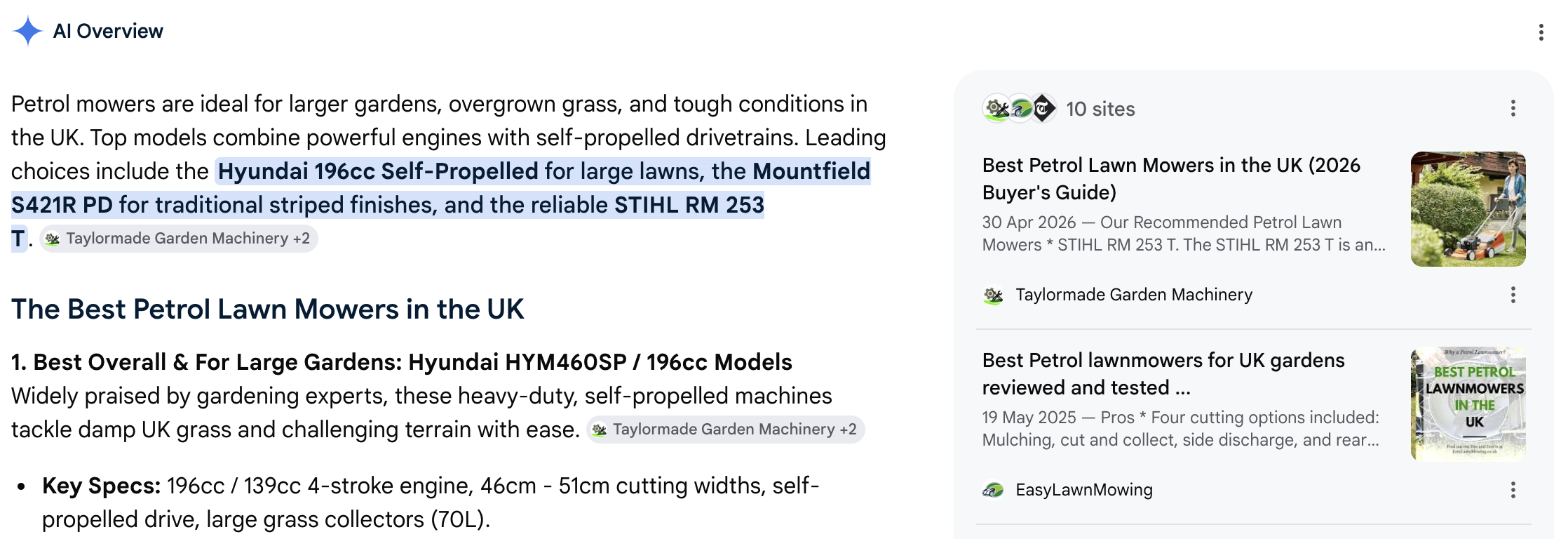
One standout success has been the AI-focused blog, ‘The Best Petrol Lawn Mowers in the UK 2026’, which alone has generated approximately 4,500 impressions. That means this one piece of content accounts for more than 60% of total visibility during the period.
This demonstrates the value of creating forward-looking, high-intent content that reflects how customers are now researching products online.
AI-related impressions are also now making up around 10% of total search impressions, which is a strong indicator of how important AI search results and visibility is becoming. This is also supported by the other product work we have managing on a regular basis for this client.
Being early matters
AI search results and brand visibility is not something businesses can afford to leave until later.
The companies that are only now starting to think about AI optimisation are already behind those that have been building the foundations over time.
Good AI visibility comes from strong SEO fundamentals: clear content, useful answers, well-written product and service pages, structured information and ongoing optimisation.
It takes time to build. That is why we have been encouraging our SEO clients to think beyond traditional search, not because SEO is being replaced, but because search behaviour is expanding.
The businesses that adapt early are the ones most likely to benefit.
AI search visibility is how easily your business, website, products or services can be found, understood and referenced by AI tools.
This might include appearing in AI-generated answers, being mentioned as a recommended supplier, or having your content used to support answers when people ask questions online.
Good AI visibility comes from strong website content, clear product and service information, relevant blog content, structured data and a strong overall digital presence.
AI matters because customers are changing the way they research.
Instead of only typing short search terms into Google, people are asking more detailed questions. They may ask AI tools to compare options, explain products, recommend businesses or shortlist suppliers.
If your website does not clearly explain what you do, who you help and why you are relevant, you may be less likely to appear in those AI-assisted search journeys.
Businesses can optimise for AI by making their website clearer, more useful and easier to understand.
This includes improving product and service descriptions, answering common customer questions, creating helpful articles, using clear page structure, strengthening technical SEO and making sure content reflects how real people search and ask questions.
The goal is to make your website useful for people, search engines and AI platforms.
AI visibility takes time to build.
Businesses that start now can strengthen their content, improve their website structure and give search engines and AI platforms clearer signals about what they offer.
Waiting too long could mean competitors gain visibility first, especially as AI becomes a bigger part of how customers search and make decisions.
Content that answers real customer questions tends to perform well, so it important that you understand who you want to talk to and what questions they are asking.
This can include helpful guides, comparison articles, FAQs, product advice, service explanations and blog content based on high-intent search queries.
For example, TaylorMade’s blog ‘The Best Petrol Lawn Mowers in the UK 2026’ performed strongly because it targeted a clear, useful question that customers were likely to ask when researching what to buy.
There is no single switch that guarantees your business will appear in ChatGPT or other AI platforms but, you can improve your chances by creating clear, useful and trustworthy content that directly answers the questions your customers are asking.
AI tools look for information they can understand, verify and confidently use in their responses. This means your website needs strong service pages, helpful articles, clear FAQs, consistent business information and well-structured content.
Traditional SEO remains important because AI platforms often rely on information already available through search engines, trusted websites and recognised online sources. The strongest approach is therefore to combine SEO with AI optimisation, helping your business become more visible wherever potential customers are researching, comparing and making decisions.