get in touch
Why Your Website Traffic Might Look Lower Than It Really Is

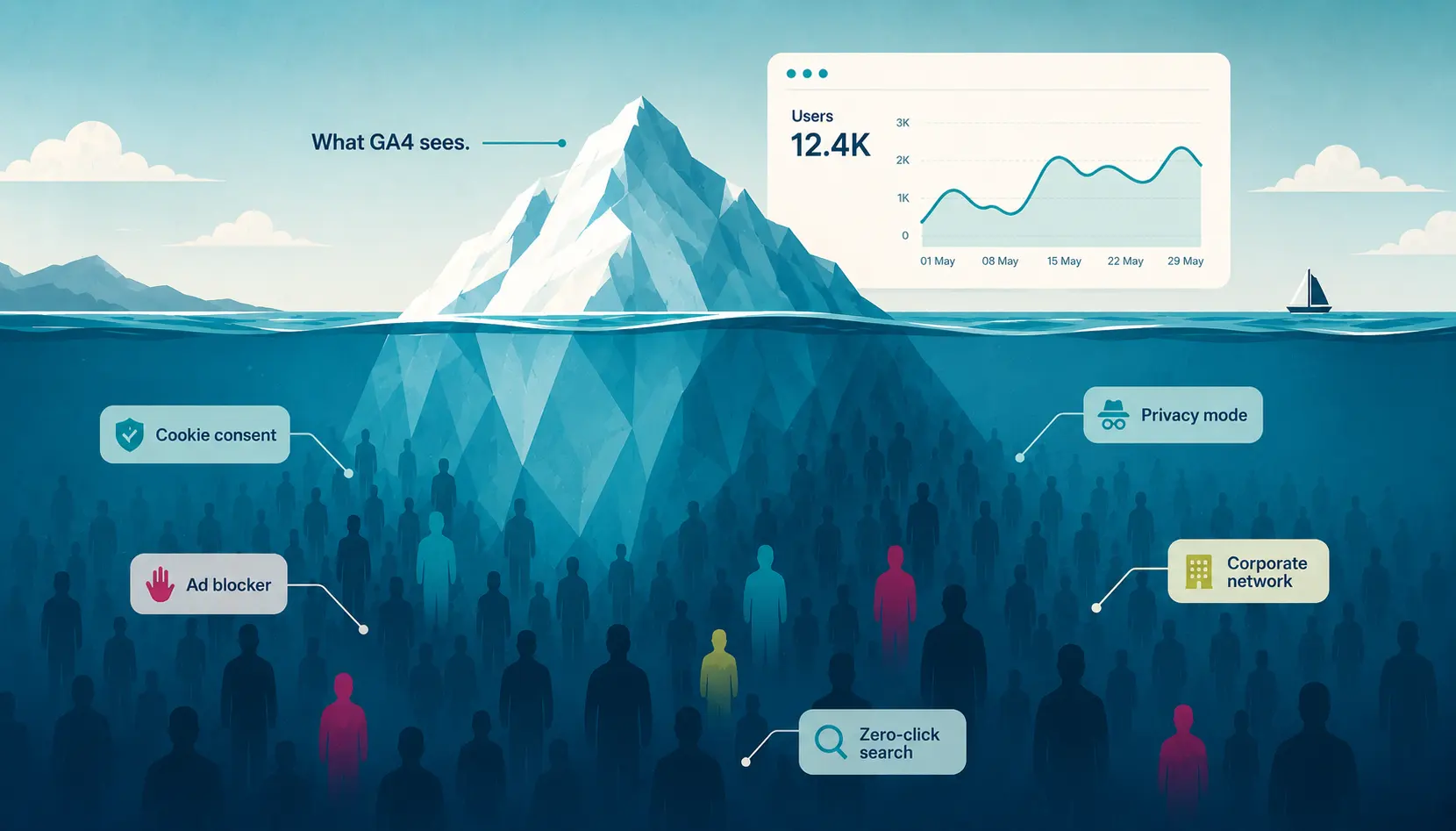
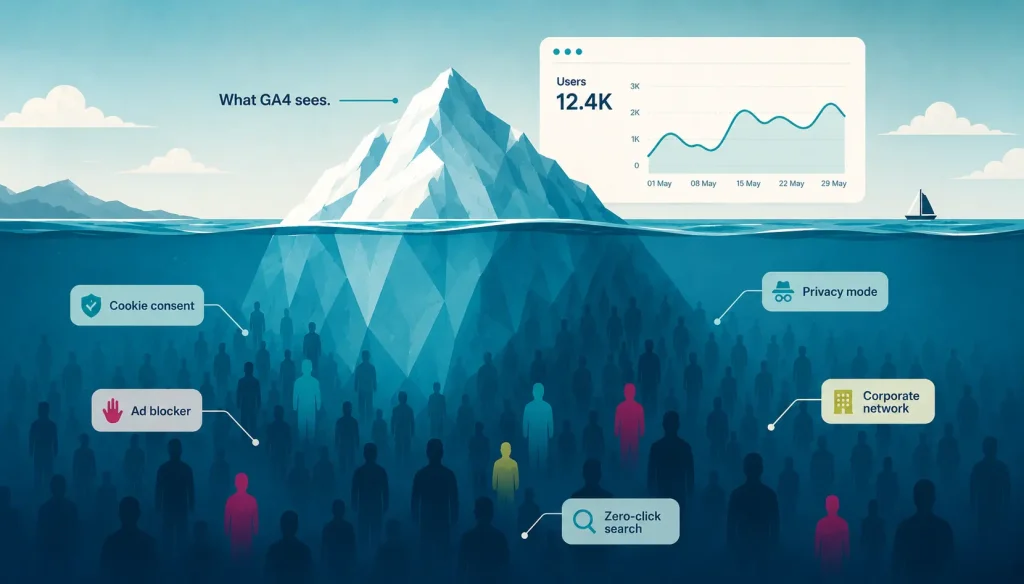
Google Analytics 4 (GA4) is useful, but it is not a perfect visitor counter. Here’s why your SEO results may be stronger than the traffic graph suggests.
You’ve invested in SEO. Pages have been improved, content has been added, technical issues have been tidied up. Then you check GA4 and the traffic looks flat – or worse, looks like it’s gone down. If you’re spending money on SEO, it’s completely reasonable to want to see the numbers moving in the right direction.
Before assuming something has gone wrong, it’s worth remembering that GA4 only records the visitors it is able, and allowed, to track. So when traffic looks lower than expected, it doesn’t always mean fewer real people are visiting your site. Often it just means GA4 is seeing part of the picture.
GA4 doesn’t count everyone
It’s easy to assume Google Analytics records every visit, but it doesn’t.
If a visitor rejects analytics cookies, uses an ad blocker, has privacy settings switched on, or is browsing from a company network that blocks tracking scripts, GA4 may not record that visit properly. They may still read your services page, check your case studies, look up your contact details, or pick up the phone later – but in GA4, they may never appear in the way you’d expect. Two specific factors push tracked numbers down:
Cookie consent banners.
Most UK and European sites now ask visitors to accept or reject tracking. If someone rejects analytics cookies – or ignores the banner – GA4 may miss them entirely. This also makes year-on-year comparisons tricky: if your cookie banner has been added or tightened recently, you may be comparing different measurement systems, not different traffic levels.
Privacy tools and corporate networks.
Ad blockers, privacy-focused browsers, and stricter business networks all interfere with Google Analytics. This matters most for B2B and professional services websites, where visitors are more likely to be browsing from workplaces with tighter security settings. From their side, nothing unusual happens – they land on your site and read what they need. From GA4’s side, the visit may be partly recorded, wrongly attributed, or missed altogether.
SEO progress doesn’t always show up as a traffic spike
SEO rarely moves in a straight line. A page can start ranking higher in Google well before it generates a noticeable increase in tracked visits. Your business may appear more often in map listings, featured snippets, or AI-generated summaries – visibility that has real value, but doesn’t always translate into a click.
There are also more “zero-click” searches now, where someone gets your name, location, reviews, or service information directly from the search results without ever landing on the site. That’s a win, even if GA4 never registers it.
That’s why traffic alone is a poor judge of SEO. Better signs include whether your pages are appearing more often in Google, whether your keywords are improving, whether your local visibility is stronger, whether more people are finding key service pages, and most importantly, whether enquiries are improving in number and quality.
Less traffic isn’t always a bad thing
This sounds counterintuitive, but a lower number can sometimes be a sign of better SEO. A website might previously have attracted visitors from searches that weren’t useful – people landing on an old blog post, finding something irrelevant, and leaving without doing anything meaningful.
Good SEO isn’t just about more people. It’s about the right people. A smaller number of qualified visitors can be far more valuable than a larger number who were never going to become customers.
The better question isn’t “has traffic gone up?” It’s: Are more of the right people finding the website, and are they taking action?
The bigger picture
None of this means GA4 should be ignored. It still shows which pages people visit, how they move through the site, and which actions they take. But it shouldn’t be treated as a perfect record of every visitor.
When we review SEO performance, we look at GA4 alongside Google Search Console impressions and clicks, keyword movement, enquiry forms, phone calls, sales and leads, popular landing pages, local search visibility, and the quality of the enquiries coming through. Together, those give a much clearer picture than one traffic graph on its own.
Sometimes traffic genuinely does drop – seasonality, competition, Google updates, technical issues, and changes in search behaviour can all play a part. But a lower number in GA4 doesn’t automatically mean fewer people are visiting your website, and it doesn’t automatically mean your SEO is failing.
So if your GA4 traffic looks lower than expected after investing in SEO, don’t panic. The real aim isn’t to push a graph upwards. It’s to make your website more visible, more useful, and more effective at attracting the right people – and that’s the picture worth measuring.
So what can be done about it?
There are practical ways to get a more accurate view of your traffic, including Google’s consent mode, server-side tracking, cross-referencing with Search Console, and using complementary analytics tools that handle privacy differently. None of these will give you a perfect headcount either, but together they can fill in a lot of the gaps GA4 leaves behind. We’ll walk through the options, and which ones are worth the effort, in a follow-up article.