get in touch
Are ChatGPT Ads worth it? What we learnt from a seven-day B2B test.

Our short answer? Promising, but a little too early to draw any firm conclusions.
ChatGPT Ads are still in beta, so we wanted to try the platform for ourselves. Not because we expected seven days of advertising to transform our business, but because we need genuine experience before advising clients for B2B and B2C businesses, and whether it deserves a place in their marketing plans.
We ran a small campaign for Gravity Digital, spent £111.45 and learnt quite a lot. Some of it was encouraging, some of it was frustrating, and much of it left us wanting to see what the platform becomes next.
What did we advertise on ChatGPT?
Our campaign targeted businesses that might be considering a new website or website redesign.
We set a daily budget of £15 (which was the minimum amount we could choose) and ran the campaign for seven days. We didn’t upload a customer list or use any existing customer data.
Instead, we supplied context hints describing conversations where our services might be relevant. These included businesses researching website costs, struggling with an outdated website or looking for a bespoke web design agency in the UK.
Unlike traditional search keywords, context hints are designed to help ChatGPT understand the types of conversations in which an advert may be useful.
We also installed the OpenAI measurement pixel on our website and used page visits as our initial conversion goal.
What were the results?
Over the seven days, the campaign delivered:
| Description | Final result |
|---|---|
| Spend | £111.45 |
| Impressions | 2,153 |
| Clicks | 56 |
| CTR – click-through rate | 2.60% |
| Average CPC – cost per click | £1.99 |
| Reported conversions | 76 |
| Page-view events | 73 |
At first glance, 76 conversions from 56 clicks looks extremely impressive. However, 73 of those conversions were page-view events rather than enquiries and we could not see what prompts displayed our ads.
A page view is still great for brand development, but it isn’t a lead. One person can also visit several pages, so the figure shouldn’t be interpreted as 73 separate potential customers.
That was one of the most useful lessons from the test: the conversion you choose makes a significant difference to how the results appear.
Next time, we would use a completed enquiry form or another meaningful action as the primary conversion, with page views treated as supporting information.
Did the campaign work?
It depends on how you define success and we have discussed at length in the office. The campaign didn’t generate a confirmed new website enquiry during the seven-day test. However, it did generate 56 clicks at an average cost of £1.99, without an uploaded customer audience or a particularly large budget.
That is encouraging.
A new website is also a considered B2B purchase. Businesses rarely see an advert, click it and immediately appoint an agency, we know that our sales process for a new website can be long, simply because it is a considered investment. There may be several people involved in the decision, budgets to approve and different suppliers to research.
Seven days is, for our business, too short to judge that kind of buying journey properly.
It is possible that services with a shorter decision-making process, especially for B2C businesses, will produce clearer results more quickly on ChatGPT Ads. It is also possible that B2B services will need longer campaigns, stronger landing pages and more carefully defined conversion goals, the same applies to Google Ads.
Our test isn’t large enough to tell us which of those is true yet.
What did we like about ChatGPT Ads?
The cost per click was relatively low, particularly for a B2B website campaign, this is also because we don’t yet have many competing ads.
We also like the idea of reaching someone while they are actively researching a subject, exploring their options or trying to solve a problem or answer a specific question.
That context could become extremely valuable. Search advertising has traditionally been driven by keywords. ChatGPT Ads potentially introduce another layer: understanding the wider subject and apparent intent behind a conversation.
We were able to begin testing this without supplying customer email addresses or relying on a large existing database.
That opens up possibilities for businesses that don’t have significant quantities of first-party customer data.
What still needs improvement?
The platform currently requires some patience, it is not straight forward and some of the goal options are unclear with little explanation.
Some of the terminology isn’t immediately clear. We had to investigate terms such as oppref, a privacy-preserving reference used to help connect an advertising click with subsequent activity on a website.
Reporting is also limited compared with more established advertising platforms. We couldn’t see the exact questions or conversations that generated clicks, which made it difficult to judge how relevant the traffic really was and to be honest this was one of the things we would have found very valuable, but I am sure that will come with time.
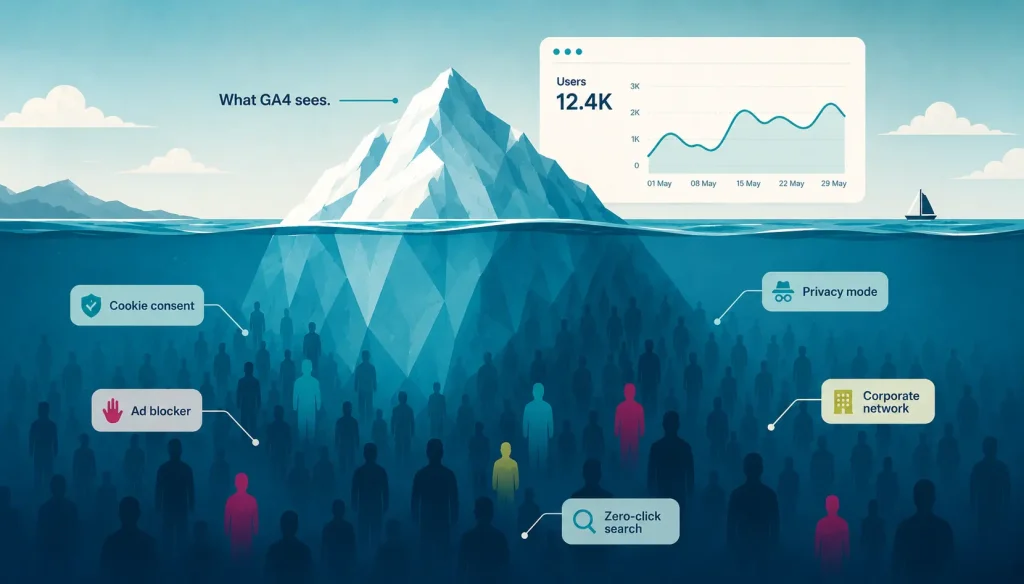
There were also differences between the number of clicks reported in Ads Manager and the traffic we could identify in GA4.
OpenAI explains that advertising clicks and analytics sessions can differ because of factors including page loading, redirects, consent settings, browser blocking and attribution. Static UTM tracking is supported, and that is something we would make sure was in place before running another campaign. OpenAI’s measurement guidance
The ad creative is also quite limited and without setting up (and adding more budget) it wasn’t possible to test how the ads appear, below is how it looks when creating the ad.
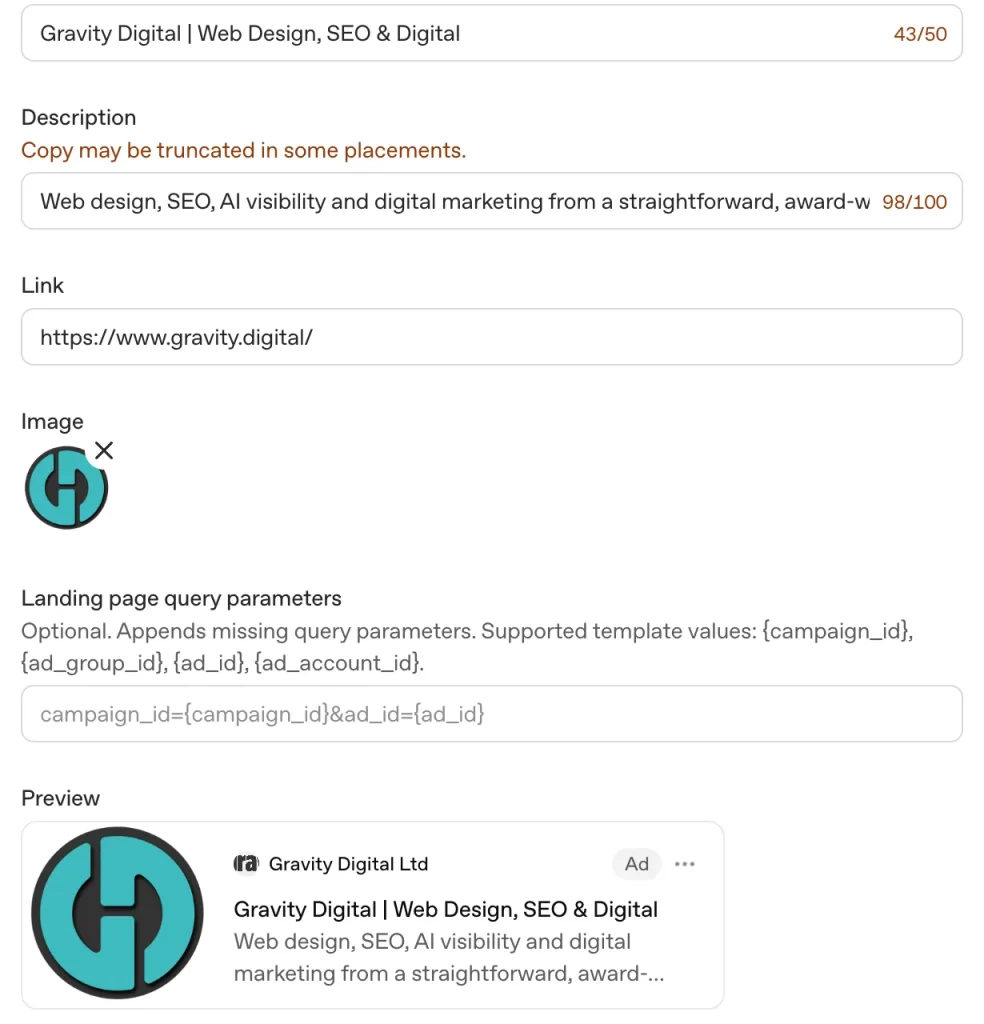

This is how the ad appears – we think!
What would we do differently in ChatGPT ads next time?
Our next test would include:
- A dedicated landing page written specifically for the campaign
- Clear UTM tracking on every advertising link
- A genuine lead action as the primary conversion
- A longer testing period
- More than one advertising message or creative
- Closer comparison between ChatGPT Ads, GA4 and website enquiries
For advising clients we would also review the business’s existing organic visibility in ChatGPT before recommending paid activity. Can ChatGPT already find and understand the business? Does the website clearly explain its services, expertise and experience? Does it answer the questions potential customers are asking?
Paid advertising and organic visibility are separate, but they should be considered together as part of the wider customer journey.
So, would we recommend ChatGPT Ads?
We wouldn’t suggest moving a large proportion of an established advertising budget into ChatGPT Ads based on this test. However, we do think the platform is worth exploring with a controlled budget, realistic expectations and proper measurement.
Our first test generated enough engagement to make us want to try again. It didn’t prove that ChatGPT Ads are an effective source of B2B leads, but it didn’t give us a reason to dismiss them either. Most importantly, we can see the potential.
Advertising alongside a relevant conversation could become a powerful way for businesses to reach people while they are researching and making decisions. OpenAI has also said that additional metrics, reporting views and insights will be introduced as Ads Manager develops.
Our verdict after seven days? It is too early to tell whether ChatGPT Ads will become an important lead-generation channel for Gravity or whether B2B services suit the way people use the platform at this stage.
But we are positive about the experience, interested in testing again and genuinely excited to see how this new form of advertising develops.